
By Patrick Ladisa | President, Yurta | Yurt Designer and Manufacturer since 2004
Executive Summary: What Makes a Yurt Succeed or Fail
Traditional yurts struggle with humidity, modern yurts often trap moisture, and both approaches overlook the realities of long-term four-season use on this continent. The long-term success of a four-season yurt depends on how its structure, materials, and design respond to regional climates and users. For over twenty years we have built, repaired or inspected many hundreds of yurts across North America and we have repeatedly observed these same patterns.
Key Findings:
- The Appeal of the Circle
The psychological draw of a circular room satisfies a deep-seated, primal human need for organic space that modern rectangular construction cannot replicate. From the womb, to the fire circle, to the first round mud huts, the circle calls to a deep well in us. - The Climate Mismatch faced by Traditional Yurts
Despite their genius, when imported into the dynamically humid, freeze-thaw cycles of North America, materials like cotton canvas, felt insulation and the wrong lumber can decay quickly. - The Modern “McYurt” Mish-Mash
Impermeable PVC coverings and bubble-wrap insulation turns small structures into condensation chambers. Systemic mold, hidden rot, and chemical off-gassing are predictable outcomes. - Key Principles for Yurt Design
A climate-resilient circular shelter demands absolute material breathability and integrity, radical minimalism for use and care and high-performance hardwoods for durability. They must abandon the suburban housing blueprint entirely.
1. Why We Love Yurts: The Enduring Call of the Circle
In all its simplicity, the yurt is one of the most sophisticated portable structures ever devised, and one of the most frequently misunderstood things for sale in the North American shelter market.
Thousands of fabric shelters erected across Canada and the United States today will fail to live up to long-term expectations. As a maker of yurts, this is disappointing because it is not a flaw in the core concept—it is arguably the opposite. Rather, modern yurt-kit designs fail because their material assumptions are fundamentally wrong for our regional climates, while the traditional central Asian alternative was never engineered to endure them.
Still every generation rediscovers the circular form. Before the right angle boxed our world neatly into subdivisions, the circle was how humans organized their lives — and we’ve never entirely forgotten it. That’s why so many walk into a quiet yurt and quickly feel safe, calm and…right. The draw of the circle is real, and calls to something deep within our psyche; a memory that precedes the living spaces of our modern world.
We’ve spent more than 20 years studying and making four-season yurts in Ontario, Canada—and anyone we meet receives an impassioned plea for yurt sanity. Far from cynical, it’s a deep reverence for what these structures are truly meant to be.
With the explosion of tiny homes in recent years, the kinds of small shelters available – including yurts – has never been more varied and plentiful. We’ve watched new yurt suppliers appear just about everywhere across the continent, and people who want to buy a yurt can often find a relatively local option. The increase is welcome because on the surface at least, there has never been a wider selection of choices for buyers of a yurt for sale in Canada or the United States.
But despite all that seeming variety, what buyers encounter falls mostly into one of two categories: an imported traditional ger, or a modern yurt kit — the kind assembled on-site from prefabricated components.
It is easy to fall in love with the traditional yurts of central Asia, like the traditional Mongolian ger—an ancient, handmade structure refined over millennia. It is brilliant in its simplicity. It’s a lightweight but strong structure that behaves more like a spring than a square box.
The apparent functionality of modern yurt kits seems at first blush to offer a better, more modern solution for a permanent yurt, a bunkie, a backyard studio, or an off-grid residence while also promising a deeper connection to the land.
Unfortunately, the traditional Mongolian yurt’s brilliance is rooted in the high, dry Asian steppes. Transplanting that approach to the humid and variable weather here to the humid forests of Ontario or the rain-soaked coasts of British Columbia and the Pacific Northwest, creates an impossible situation for tradition.
Meanwhile, despite the growth of the Canadian and US yurt kit market, the typical modern yurt seems always to forgo traditional wisdom both structurally and functionally. By approaching it like standard housing, manufacturers have created a “design mish-mash.” Akin to a domestication effort, it attempts to solve the problems of a small, flexible shelter with a suburban housing paradigm. It is a categorical error.
To understand why many fail, it helps to understand first what makes a true yurt work.
2. Traditional Yurt Architecture: Engineering Genius Meets Regional Realities
Traditional Mongolian yurts represent one of the most elegant lightweight building systems ever conceived; but they emerged in an environment very different from North America.
Monolithic Engineering: How Structural Unity Defies Wind and Snow Load
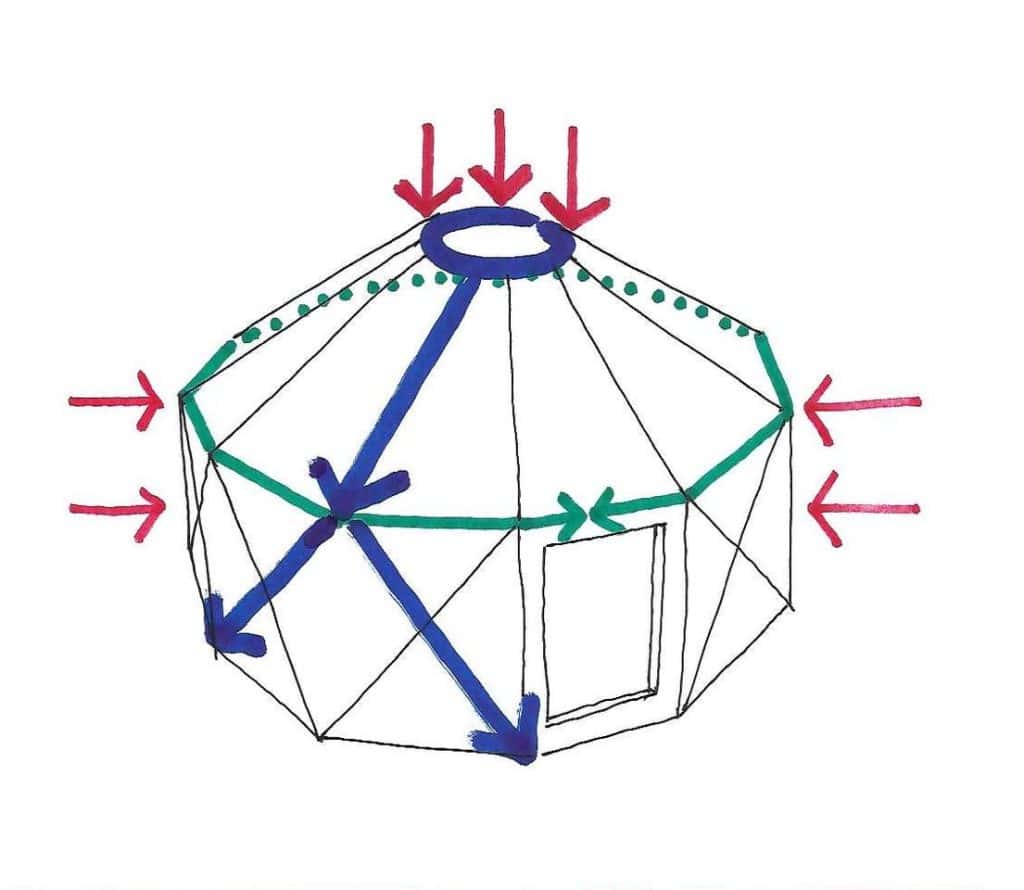
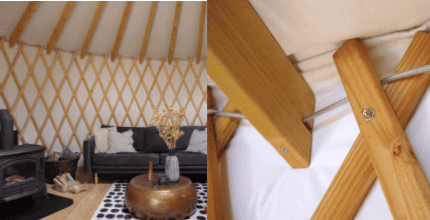
The defining strength of a traditional yurt is that every structural element participates in carrying load — roof, wall, and cover working as one unified system. Unlike a rigid square building, a yurt is a spring that flexes and compresses as one element. The brilliance of Mongolian traditional yurts in particular, lies in this Structural Unity: the roof locks onto a circular lattice wall. Traditionally, roof struts are tied individually to the wall lattice. Roof and wall form one monolithic system where every component works in concert and load is transferred effectively through the structure. A yurt is not just a round tent – its structural dynamics and architectural mechanics are the very expression of its genius.
Brilliant load distribution is why traditional engineering can carry snow loads far beyond what their minimal frame suggests to western eyes. With a shape that naturally shears wind exceptionally well, they are capable of handling extreme wind loads of +100km/h. The compression ring at the top, the round base, the covers…all work together to create a structure of rare elegance. It deserves all the adoration it gets.
Nomadic Portability: The Core Philosophy of a True Yurt
Portability is not a secondary feature of the traditional yurt—it is the very principle around which the entire structure developed. The traditional ger was masterfully engineered to be completely assembled, struck, and transported by a small team without a single nail, screw, or mechanical tool. It was engineered for a nomadic life. Even today, the seasons may move families between a summer and a winter pad. Structures are sometimes painted ornately and beautifully. But the yurt’s minimal footprint and radical portability are the essence of its beauty and its value to any user, anywhere. That minimalism is the very thing that draws new users to all yurts in the first place.
The Geographic Disconnect: Why Humidity Kills Traditional Yurts
A four-season yurt in Canada faces conditions no traditional ger was ever designed to endure. Mongolia is bone-dry. Moisture across the North American continent is another matter completely — varied, relentless, and seasonal in ways that place totally different demands on yurt materials. Prolonged freeze-thaw cycles and winter heating rhythms push significant condensation into any enclosed space. A yurt in Ontario lives through humidity fluctuations that can vary 100% daily. We love the ger deeply, but its performance in our climate remains limited.
Out of the box, most cotton canvas yurts simply cannot withstand sustained rains without leaking. A common workaround is the introduction of house-wrap material like Tyvek beneath the canvas cover to shed the water the canvas cannot. The irony of integrating suburban construction materials into a traditional structure to compensate for its limitations says much about the atmospheric mismatch.
- Atmospheric Moisture: When Humidity Triggers Mold and Decay
Traditional materials like raw wool felt and untreated organic cotton canvas act as massive sponges when exposed to steady relative humidity. These materials were meant to breathe in a dry climate. Continued moisture can lead to mold and material decay. Often-rudimentary central dome systems and a lack of windows minimize airflow that encourage the thick rolled-felts and natural fibres to retain moisture. The accumulation and persistence of humidity steadily degrades traditional materials.
- The Rot Cycle: How Moisture Degrades Traditional Structures
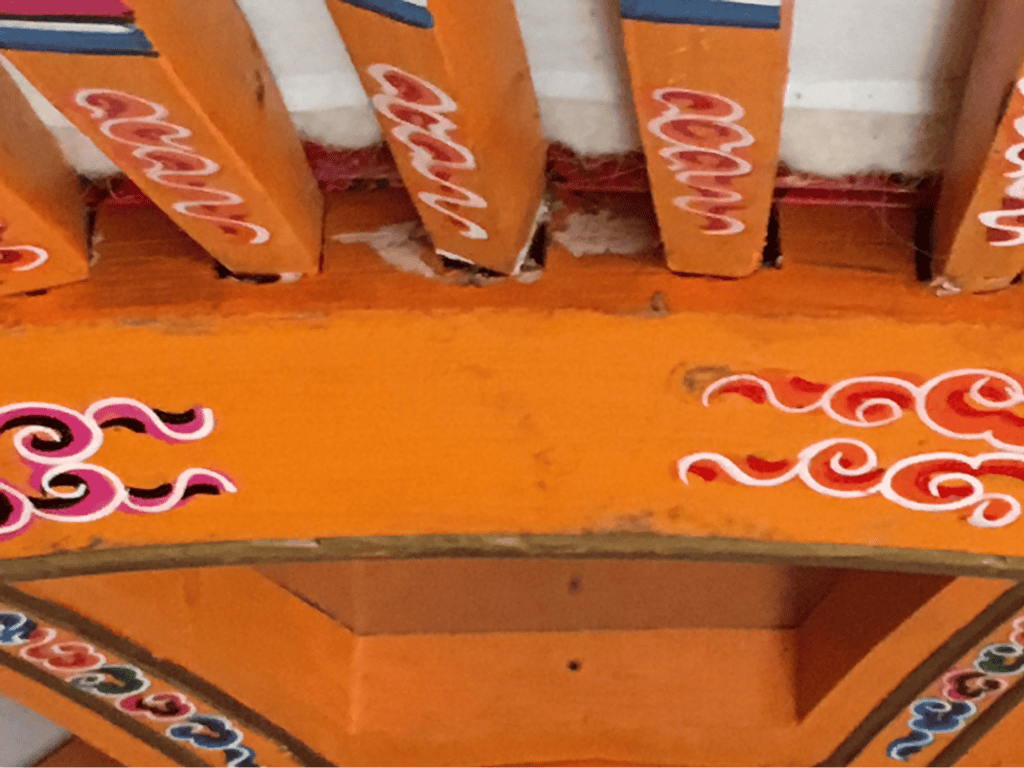
Repeated wetting and drying cycles place extraordinary stress on yurt materials. Low-density wood species exposed to constant, regional freeze-thaw cycles rapidly crack and split. Compression rings, doors and lattices made with traditional materials often lack the fibre density to withstand the rot-pressures of our environment. Construction glues and methods are not graded for our use. The checking, splitting, and cracking of these wood elements exposed to our repeated humidity fluctuations is, sadly, not uncommon. The delamination of toono (central compression rings), is a known issue, as is the unfortunate degradation of once-beautifully ornamented traditional gers; a material vulnerability explored in structural forestry studies by the USDA Forest Service. The delamination, the splitting, and the rot are predictable consequences of choosing the wrong materials for the climate.Z
- Weathering: Why Cotton Canvas Fails Outdoors
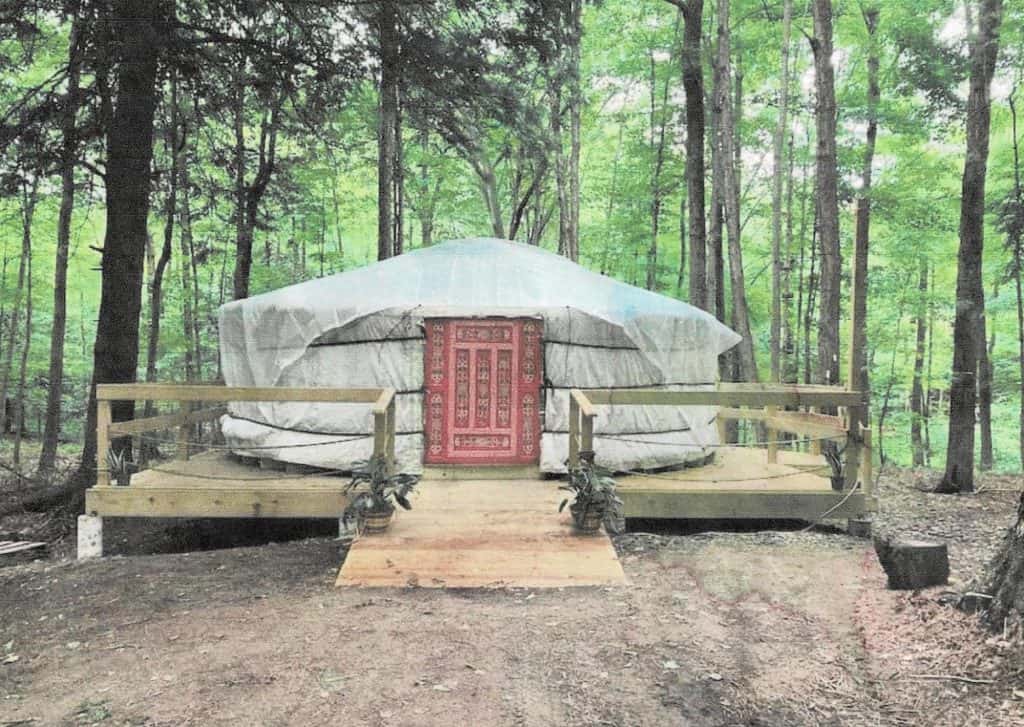
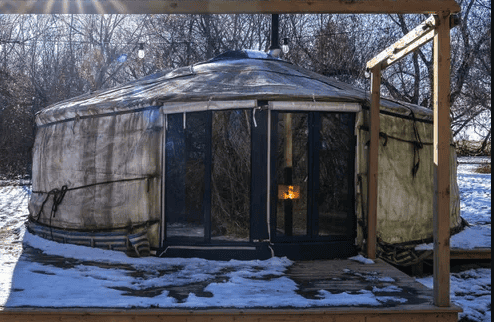
Cotton fabrics suffer rapid UV breakdown and weave degradation when left exposed to the elements twenty-four hours a day. The typical authentic yurt imported into Canada and the United States today is a canvas yurt: fitted with a cotton canvas outer cover that, while highly breathable, deteriorates rapidly under continuous outdoor exposure. Although we have worked with this type of canvas in the past for its high breathability, we discontinued its use many years ago due to its rapid deterioration and short service life. In our experience, uncoated fabrics like cotton canvas lose their material integrity within about five years. Degradation occurs to the cotton weave itself making a tear as easy as pushing a finger through the fabric. It’s important to note also that fabrics milled overseas may not meet local regulations like the NFPA 701 standard for fire retardancy or Canadian flame-resistance standards for tents.
Functional Gaps: Limitations of the Nomadic Ger for Modern Living
A structure optimized for seasonal migration inevitably makes compromises when adapted to modern, semi-permanent demands. Traditional yurt design encapsulates a way of life that contradicts contemporary North American use. An authentic ger with a wall height of 4.5 to 5 feet makes perfect sense on the windswept steppes. But it’s an unnecessary limitation for users who expect to stand up throughout. Central supports under the toono (compression ring) also divide and limit the availability of clear space.
There is also an uncomfortable reality in a traditional yurt. Despite its beauty, it can sometimes feel stuffy. Traditional yurts rely on the central opening (tonoo) for light and they typically lack windows. They also possess a visually-dense softwood roof structure and wall lattice which can end up making the interior spaces feel darker and more restrictive.
A structure that was extraordinary in its original context can become a liability when the design doesn’t adapt.
The lack of operable domes and adequate windows makes managing interior moisture a more rigorous discipline. The maintenance rhythms of the accompanying nomadic life — where coverings are regularly removed and maintained— simply don’t exist in the typical fixed installation of the western world. Without that constant attention, traditional Mongolian yurts can be a heartbreaking aesthetic disappointment and practical frustration in Canada and the United States. The low walls, limited light, and maintenance demands only make sense when you’re always about to pack up and move.
Enter modern yurts with the suburban blueprint.
3. The McYurt Compromise: How Modern Yurts Lost Their Way
In solving the material limitations of authentic yurts, modern manufacturers sacrificed traditional structural wisdom for suburban convenience. They produced a “tent pretending to be a house.” We call it the McYurt: Strip away the brand names and cosmetic finishes, and almost every modern yurt repeats the exact same standard design.
Though modern manufacturing introduced new ideas to four-season yurts that we consider misplaced, two important contributions must be acknowledged in any modern yurt review. Modern makers introduced the concept of circular living to the west. This helped bring yurts into the popular culture and introduced a new generation of users to the possibilities of a circular space. For many, a modern yurt was their first experience with a round room, a fabric shelter, or a lighter touch with the landscape around them.
It also expanded the range of sizes available to users making circular shelters in footprints large and small enough to serve as studios, guest houses, classrooms, and full-time, multi-room residences. To say nothing of the wide popularity of yurt glamping in the recent decade that has gone mainstream. This flexibility broadened the practical applications of yurts and helped create the vibrant yurt market that exists today.
However, the industry’s response to temperate continental climates often focused on making yurts behave more like conventional houses rather than refining what made them unique. In solving some practical problems, many manufacturers abandoned the structural elegance, portability, and material honesty of the traditional ger. The outcome was a new category of shelter that succeeded commercially, but often at the expense of the principles that inspired it.
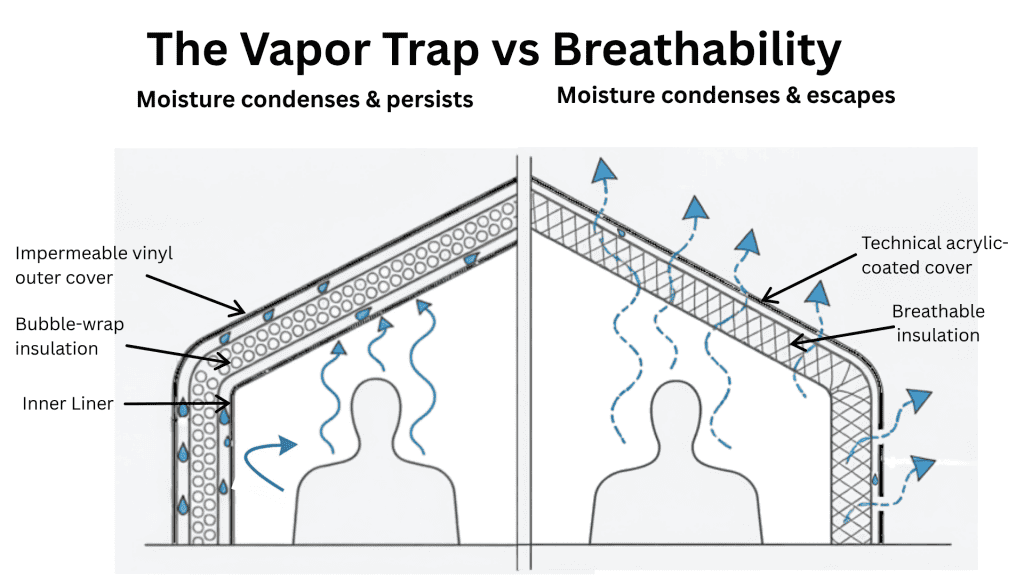
The Vapor Trap: Impermeable Vinyl Creates Systemic Yurt Condensation
The single most common failure in modern yurts begins with the most common building envelope: impermeable vinyl. Wrapping a small, unvented living space in a completely non-porous shell creates an inescapable indoor moisture chamber that introduces systemic moisture issues in four-season yurts.
The defining material of the modern yurt is vinyl. While cheap and readily available, its total impermeability is a liability in a small shelter. A vinyl yurt cannot breathe. Every breath we take adds moisture to a sealed envelope—roughly one litre of water per person, every single day, as documented by scientific data on human respiration and environmental moisture.
A Double-Layered Plastic Bag: The Hidden Physics of Bubble Wrap Insulation
When bubble-wrap insulation is trapped between interior and exterior vapor barriers, moisture has nowhere to escape. While effective at first glance as a simple radiant barrier, bubble-wrap is a functionally catastrophic material choice for yurt insulation. Endemic yurt condensation issues are compounded by this standard material where any gap and potential breathability is often completely sealed off with tape around the frame. Sandwiching plastic bubble wrap between an outer vinyl cover and an inner liner creates a double-layered plastic bag. Condensation doesn’t just collect; it persists out of sight.
Where condensation persists, mold follows. Not just common sense, established building envelope science confirms that trapping moisture between two impermeable vapor barriers is a guaranteed recipe for rot, a matter detailed in the Building Science Corporation’s guide on residential vapor barriers.
The Maintenance Myth: The Constant Attention Modern Yurts Demand
Yurt lifespan and maintenance is not primarily determined by the owner’s diligence but rather largely by the simplicity of its design and the breathability of its covers. Minimalism is a deliberate strategy to drastically reduce the owner’s maintenance burden over a yurt’s lifespan.
Keeping every element minimal and clean puts the entire yurt within easy reach for routine care. By stripping away suburban housing components and maintaining a streamlined, accessible design, hidden cavities where rot and neglect quietly compromise a structure are eliminated. Modern yurt wall covers for example are typically screwed into a round platform every 18 inches or so. The roof and wall covers are often laced together tediously. These two simple design choices alone create a real obstacle for owners to maintain their vinyl covers properly. Few will open covers, manage the taped insulation and air out the layers with the rigour that vinyl demands.
Modern yurts are how Harry describes Sally in the movie When Harry met Sally. They are: “The worst kind: they’re high-maintenance but they think they’re low-maintenance”. That’s why most any online modern yurt forum or discussion group will be littered with stories of owners discovering and battling mold in even new PVC vinyl yurts. A predictable outcome given the science of moisture.
Yurt vs Ger: Comparing Modern Kits and Traditional Yurt Structures
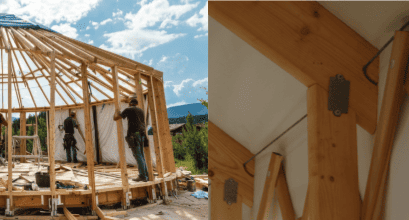
Structurally, modern yurts are not even yurts at all. Traditional yurts rely on physics, while modern yurt kits rely on hardware. Despite their similar appearance, modern yurts have more in common with standard North American sheds. No unified load distribution. No spring action. No yurt logic.
In modern design, commercially-available 2×4 wall studs are mounted to the floor with conventional building hardware in a circle. Roof struts are screwed onsite to the wall studs with mending plates. Often, roof rafters are left “hanging” on the tension cable. The lattice wall wraps around this frame but is usually ornamental serving little, if any, structural purpose.
Conventional building components like glass windows and air conditioning inserts are shoehorned-in, further limiting any flex in the lightweight shelter. All structural logic of the traditional ger is abandoned in favour of a familiar but confusing mish-mash of textures.
Indoor Air Quality: Why That Yurt Smell is a Warning
Material selection is not only a question of durability but also the quality of the indoor environment occupants experience every day. Ironically, PVC vinyl introduces chemical toxicity and industrial volatile organic compounds (VOCs) into what should be an indoor sanctuary in nature. The familiar smell on vinyl is actually off-gassing that may contribute to respiratory irritation, damage to the central nervous system, liver and kidneys, nausea, headaches and loss of coordination. And that’s just the start.
Vinyl Chloride is manufactured exclusively for polymerization into polyvinyl chloride (PVC). Its toxic chain from extraction, manufacture, disposal and use is explored in gory detail in a study on the impacts associated with plastic polymers published in the NIH library. (https://pmc.ncbi.nlm.nih.gov/articles/PMC11253235/
The only place for vinyl is on your turntable.
Wrapping a small shelter in PVC or impermeable bubble wrap is an invitation to systemic failure.
The Aesthetic Sacrifice: Modern Yurt Kits Lack Architectural Finesse
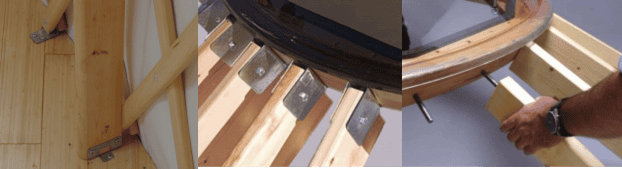
The interior finished space of a typical modern yurt does not embrace architectural refinement, it reflects manufacturing efficiency. The solution to hiding unsightly bubble wrap for example, is commonly the use of zip ties to hang an interior canvas liner. The central compression rings are rarely circular, replaced by easier-to-make octagons and decagons of standard lumber. Glass windows are generally small. Standard galvanized mending plates abound as a primary building element and reliance on hardware — not design and physics — contribute to a clunky fit and finish.
Modern yurts lack the elegance and portability of the traditional ger which impedes ongoing maintenance. At the same time, they lack the mechanical systems and longevity of a hard building that can manage the envelope. The resulting McYurt occupies an uncomfortable middle ground that serves neither impulse well.
But, it is a circle and on the surface, it passes for a yurt.
4. The Blueprint for High-Performance North American Yurts
The failures of both traditions point toward the same conclusions. Millennia of traditional wisdom and decades of modern experimentation converge in a clear set of design principles for making durable yurts for the extreme weather conditions found across Canada.
Vapor Permeability: Why Yurt Material Breathability is Non-Negotiable
A yurt is, at its core, a dynamic tent system and its outer skins must remain entirely vapor-permeable to eliminate structural condensation. No single consideration is more important. If the skin of the yurt is wrong, nothing else really matters. A tent MUST breathe to prevent the accumulation of moisture and mold. Acrylic-coated fabrics are non-toxic and provide breathability and durability to UV exposure. Unlike cotton canvas, which absorbs and holds moisture before releasing it, a quality acrylic-coated polyester for example allows vapor to pass through the weave while resisting UV degradation and surface weathering — a meaningful balance between breathability and long-term durability that vinyl never achieves.
Fewer Moving Parts: Minimalism Drives Long-Term Performance and Care
Every single knot, screw, rope, assembly or seal that must be managed impedes maintenance and visibility through the changing seasons. When removing a cover for seasonal inspection takes minutes rather than an afternoon of unscrewing hardware from wood — hardware that loosens and strips— owners actually do it. That ease separates a yurt that gets maintained from one that quietly fails.
True Portability: Engineering for Structural Adaptability and Relocation
A yurt designed for Canada, or the humid continental climate must balance rugged, four-season resilience with the ability to be rapidly struck, packed, and moved without heavy machinery. Deployment should require minimal tools and minimal parts. The structure should go up and come down without driving a single screw into wood. When a lightweight structure is permanently fixed by the friction of its own complexity, it has a finite value. A yurt that can be relocated easily is one that actually gets relocated, and that adaptability is precisely what makes the long-term economics of yurt ownership work. The long-term value — and ultimately the real yurt cost — is determined not by the purchase price but by how long the structure performs without failing.
Material Integrity: Selecting Safe, Non-Toxic Materials for Extreme Weather
Achieving true climate resilience in a fabric shelter starts with material selection: the right hardwoods, non-toxic coatings and breathable insulation composites. The most effective yurt insulation solutions bring together the thermal mass of traditional materials with modern radiant layers while remaining breathable. A wool felt layer needled directly to a reflective substrate, for instance, combines the breathable insulation of the ger tradition with radiant heat retention that synthetic bubble wrap cannot replicate. The result is an insulation layer that manages moisture rather than trapping it.
Functional Design: Maximizing Space, Airflow and Usability
A high-performance yurt must optimize interior volume and airflow through expansive, strategic window placement and highly functional, operable dome ventilation. In addition, full standing height throughout and a clear span without central supports are the baseline for a structure people will actually live in. Functionality such as additional vents for bathrooms or heat sources should be easy to incorporate where needed.
It’s more than simple aesthetics. A yurt with inadequate ceiling height forces occupants to hunch at the perimeter — friction that can erode the appeal of the space over time. A dome that cannot be operated from inside during a humid summer rain becomes a hard choice between ventilation and getting wet. A dome adjustable to vent with or against prevailing winds as needed gives occupants control without compromise. Functional design in a yurt makes the difference between a structure that works with its occupants and one that quietly works against them.
In Summary: Honoring Wisdom in a Modern World
The challenge of modern yurt design is not improving upon the circle, but understanding its ancient wisdom. The circular form remains one of humanity’s most ingenious architectural legacies. It is a way of living that builds connection with the world rather than a fortress against it.
But not all yurts do this well on our continent. For its brilliance, the traditional Mongolian ger struggles in our relentless humidity. Modern yurts trade breathability and structural logic for a “design mish-mash” that eventually fails the user.
Decades of studying yurts has not changed our admiration for them. If anything, as a Canadian yurt manufacturer, it has deepened it. The traditional ger is one of the most elegant portable structures ever devised and modern experimentation has revealed both new possibilities and new mistakes. The lesson is not that yurts fail. It’s that a shelter reflects the assumptions built into it.
A yurt is ultimately a conversation between its climate, materials, structure, and the people who inhabit it. When those elements work together, the result is not simply a shelter that survives—it is one that continues to reward its occupants for decades. That, perhaps more than anything, is the lesson twenty years of designing yurts in North America has taught us.
About the Author
Patrick Ladisa is President of Yurta, manufacturer of high-performance yurts made in Canada for life in North America since 2004. His work focuses on lightweight but strong structures with particular emphasis on shelter breathability and long-term performance in four-season conditions. He has consulted on yurt installations from Nova Scotia to British Columbia and from Baffin Island to the Australian Outback. He continues to advocate for practical, sustainable, and human design while manufacturing responsibly and sustainably in an industry he believes has lost its way.
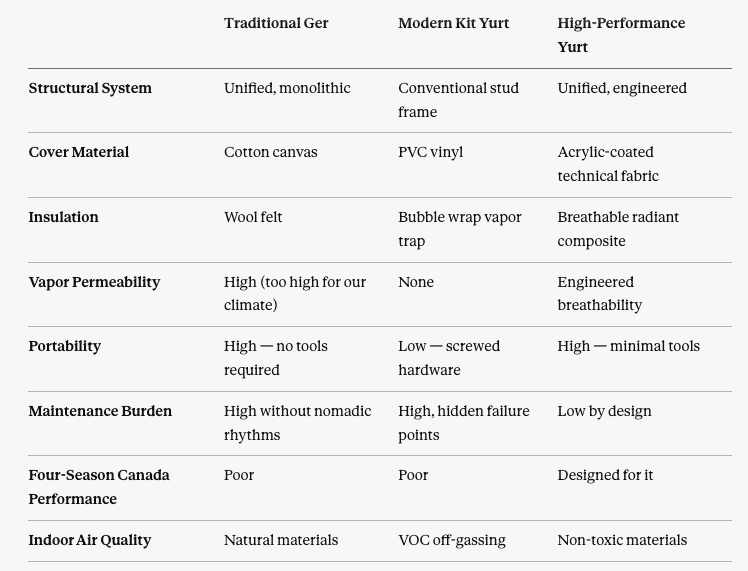
| Feature / Metric | Traditional Ger PDF | Modern “McYurt” Kit PDF | High-Performance Yurt |
| Structural System | Unified, monolithic framework | Conventional building 2×4 frame | Unified, monolithic framework |
| Cover Material | Untreated organic cotton canvas | Non-porous PVC vinyl roof or wall | Acrylic-coated technical fabric |
| Insulation | Raw wool felt layers | Bubble wrap radiant vapor trap | Breathable radiant wool felt composite |
| Vapor Permeability | High (frequently too high for damp regions) | None (creates internal condensation) | Technical fabric breathability |
| Portability | High (zero tools or hardware required) | Low (screwed together) | High (no tools or hardware) |
| Maintenance Burden | Moderate (demands traditional nomadic care cycles) | High (creates hidden failure points) | Low (engineered for easy access) |
| Four-Season Performance | Poor in dynamically humid zones | Poor (susceptible to sub-layer rot and mold) | Specifically designed for humidity |
| Indoor Air Quality | Natural materials (potential mildew dampness) | Industrial VOC chemical off-gassing | Non-toxic and natural material components |